Showing posts with label erlang. Show all posts

Sunday, December 09, 2012

Code Retreat 2012

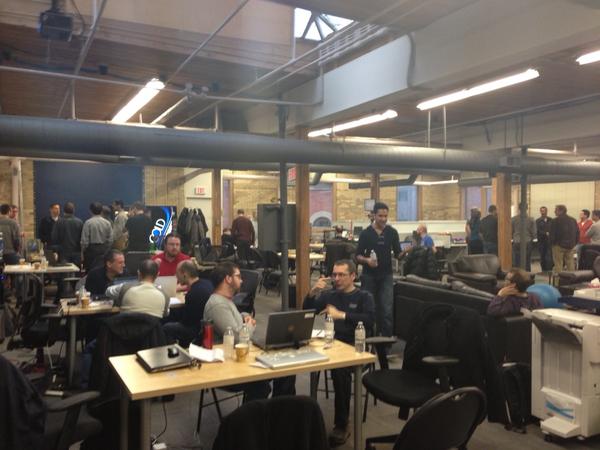
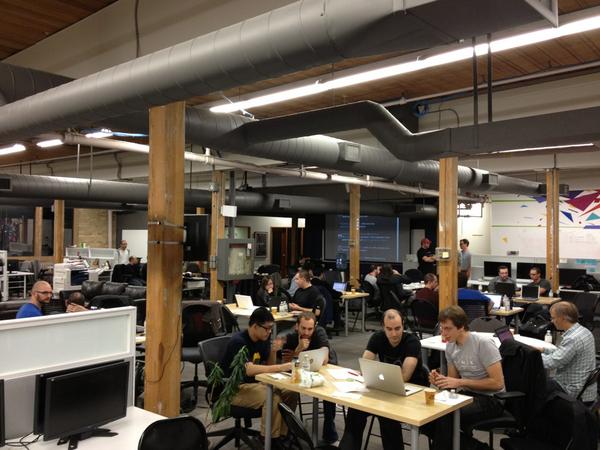
Yesterday was the Global Day of Code Retreat. Software engineers around the world met together to learn from each other.

There were several sessions where people were sitting in pairs, programming Conway's Game of Life.

Each session you choose a new partner, so that you both can learn something new.

1. During the first session my partner and I decided to implement the Game in Java, mainly because it was the language she was most comfortable with. We implemented the procedural solution using two-dimensional array and nested loops. At that moment that was the only solution I could think of. The main challenge was to cover all edge cases and fix all ArrayIndexOutOfBoundsExceptions. Java is fairly verbose language, and with nested loops and if-else statements the final solution was pretty hard to read. You can see here how it might look like.

2. First session was a warmup, during which most people realized that programming arrays is a tedious work. For the second session my new partner suggested an object-oriented approach, where you would operate on Cell objects that would encapsulate coordinates on the grid. In this case you move the game logic from the grid to the cell, making it easier to calculate a new state. This was my first acquaintance with C#. Interesting language. Basically, Java with lambdas. Here is an example of C# implementation. Our solution was very similar.

3. If the first session's data structure was array of booleans, at the second session it was replaced by a list of objects. The next step would be to relax the data structure even further. We decided to experiment with un-ordered set of coordinate pairs. For language we chose Clojure. Although we didn't finish the implementation, by the end of the session we had a clear picture how to solve the problem in functional style.

4. On the fourth session the facilitators put an interesting constraint: the coding must be done in absolute silence. That was the most amazing experience of the day. Before we started I thought we couldn't accomplish much without talking. As it turned out, we could. The key in silent coding is to use the tools which both partners are familiar with. In our case we both were advanced users of Vim, and we knew Lisp languages. Our Clojure implementation was based on map/filter/reduce approach and spanned 20 lines of code. Later on, I found Christophe Grand's 7-line solution based on list comprehensions. It is so wonderful that I want to reproduce it here

(defn neighbours [[x y]]
  (for [dx [-1 0 1] dy (if (zero? dx) [-1 1] [-1 0 1])]
    [(+ dx x) (+ dy y)]))

(defn step [cells]
  (set (for [[loc n] (frequencies (mapcat neighbours cells))
             :when (or (= n 3) (and (= n 2) (cells loc)))]
         loc)))

5. For the last session we chose Erlang. Because we already knew how to implement the functional solution, that was an exercise of translating Clojure code into Erlang. Unfortunately we didn't find an equivalent of frequencies() function, so we implemented it ourselves. Other than that, the Erlang code is identical to Clojure.

-import(lists, [flatmap/2]).
-import(sets, [from_list/1, to_list/1, is_element/2]).

neighbours({X, Y}) ->
    [{X + DX, Y + DY} || DX <- [-1, 0, 1], DY <- [-1, 0, 1], {DX, DY} =/= {0, 0}].

step(Cells) ->
    Nbs = flatmap(fun neighbours/1, to_list(Cells)),
    NewCells = [C || {C, N} <- frequencies(Nbs),
                     (N == 3) orelse ((N == 2) andalso is_element(C, Cells))],
    from_list(NewCells).

frequencies(List) -> frequencies(List, []).
frequencies([], Acc) -> Acc;
frequencies([X|Xs], Acc) ->
    case lists:keyfind(X, 1, Acc) of
        {X, F} -> frequencies(Xs, lists:keyreplace(X, 1, Acc, {X, F+1}));
        false  -> frequencies(Xs, lists:keystore(X, 1, Acc, {X, 1}))
    end.

Summary

During one day I learnt a lot: new language, new abstractions, new techniques, new ways of communication, new ideas. I met bunch of smart people. I was so overwhelmed with all this cool stuff that I had to write this blog post to offload it from my head.

If you are a programmer and you've never been at Code Retreat, I strongly encourage you to do it next year. It's exciting experience.

And, of course, thanks to all the people who made it possible.

Wednesday, November 10, 2010

Erlang explained: Selective receive

If you worked with Erlang you've probably heard about selective receive. But do you actually know how it works? I want to post here an excerpt from Joe Armstrong's book Programming Erlang where he explains how it works exactly (Section 8.6, p.153):

receive
    Pattern1 [when Guard1] -> Expressions1;
    Pattern2 [when Guard2] -> Expressions2;
    ...
after
    Time -> ExpressionTimeout
end

  1. When we enter a receive statement, we start a timer (but only if an after section is present in the expression).
  2. Take the first message in the mailbox and try to match it against Pattern1, Pattern2, and so on. If the match succeeds, the message is removed from the mailbox, and the expressions following the pattern are evaluated.
  3. If none of the patterns in the receive statement matches the first message in the mailbox, then the first message is removed from the mailbox and put into a "save queue." The second message in the mailbox is then tried. This procedure is repeated until a matching message is found or until all the messages in the mailbox have been examined.
  4. If none of the messages in the mailbox matches, then the process is suspended and will be rescheduled for execution the next time a new message is put in the mailbox. Note that when a new message arrives, the messages in the save queue are not rematched; only the new message is matched.
  5. As soon as a message has been matched, then all messages that have been put into the save queue are reentered into the mailbox in the order in which they arrived at the process. If a timer was set, it is cleared.
  6. If the timer elapses when we are waiting for a message, then evaluate the expressions ExpressionsTimeout and put any saved messages back into the mailbox in the order in which they arrived at the process.


Did you notice the concept of "save queue"? That's what many people are not aware of. Let's play with various scenarios and see the mailbox and save queue in action.

The first scenario is simple, nothing to test there in regards to mailbox. The second one is also straightforward:

1> self() ! a.
a
2> process_info(self()).
 ...
 {message_queue_len,1},
 {messages,[a]},
 ...
3> receive a -> 1; b -> 2 end.
1
4> process_info(self()).
 ...
 {message_queue_len,0},
 {messages,[]},
 ...

You send a message to the shell, you see it in the process mailbox, then you receive it by matching, after which the queue is empty. Standard queue behaviour.

Now let's test scenario 3,5:

1> self() ! c, self() ! d, self() ! a.
a
2> process_info(self()).
 ...
 {message_queue_len,3},
 {messages,[c,d,a]},
 ...
3> receive a -> 1; b -> 2 end.
1
4> process_info(self()).
 ...
 {message_queue_len,2},
 {messages,[c,d]},
 ...

Again, no surprises. Actually, this example demonstrates what people think when they hear about selective receive. Unfortunately we don't see what happened internally between lines 3 and 4. We are going to investigate it now by testing scenario 3,4.

This time start the shell in distributed mode so that we can connect to it later from the remote shell.

(foo@bar)1> register(shell, self()).
true
(foo@bar)2> shell ! c, shell ! d.
d
(foo@bar)3> process_info(whereis(shell)).
 ...
 {current_function,{erl_eval,do_apply,5}},
 ...
 {message_queue_len,2},
 {messages,[c,d]},
 ...
(foo@bar)4> receive a -> 1; b -> 2 end.

At this moment the shell is suspended - we are exactly at step 4. Go to remote shell, and type the following:

(foo@bar)1> process_info(whereis(shell)).
 ...
 {current_function,{erl_eval,receive_clauses,6}},
 ...
 {message_queue_len,0},
 {messages,[]},
 ...

That's interesting: no messages in the mailbox. As Joe said, they are in the save queue. Now send a matching message:

(foo@bar)2> shell ! a.
a

Go back to initial shell, which should be resumed now, and check the mailbox again:

1
(foo@bar)5> process_info(whereis(shell)).
 ...
 {current_function,{erl_eval,do_apply,5}},
 ...
 {message_queue_len,2},
 {messages,[c,d]},
 ...

That's what we saw in the previous test, but now you know what happens behind the scenes: messages are moved from the mailbox to the save queue and then back to the mailbox after the matching message arrives.

Now you should understand better how selective receive works. Next time you explore your Erlang process, keep in mind the save queue and disappearing and reappearing messages.

Saturday, November 06, 2010

Book review: Erlang and OTP in Action

Title: Erlang and OTP in Action
Author: Martin Logan, Eric Merritt, and Richard Carlsson
Paperback: 432 pages
Publisher: Manning Publications; November 2010
Language: English
ISBN-10: 1933988789
ISBN-13: 978-1933988788
$38.99 (amazon.com)

Overview

Even though this book has Erlang in its title, it's only about 15% of the content dedicated to Erlang language itself — the biggest portion of the book is about OTP. Nowadays, when more and more developers get familiar with Erlang, they need a new book that can boost them to the next level of proficiency, where they can produce industry standard code leveraging all the power of Erlang platform. This book is supposed to fill this gap!

Part One — The OTP basics


Chapter 1 — The Erlang/OTP platform

This chapter gives an overview of the important concepts and features of Erlang/OTP: concurrency, fault-tolerance, distribution. It discusses four inter-process communication paradigms — shared memory, STM, futures, message passing — and shows how the latter makes the distribution trivial to implement in Erlang. You will see how the linked processes and supervision trees build the foundation of Erlang famous fault-tolerance, and how three aspects of Erlang runtime system — sophisticated scheduler, non-blocking IO, and per-process garbage collection — complete the picture.

Chapter 2 — Erlang language essentials

Take a deep breath — this long chapter is going to be an Erlang Crash Course. If you already worked with the language, most of it won't be new for you, but it's still worthy to read it because there are many small things that you are probably not aware of or don't use very often. For example,

• are you familiar with all available shell functions, and break menu options?
• do you know how to work with multiple shells in one window?
• how lists are implemented internally, and how to use ++ operator efficiently?
• what's the difference between arithmetic and exact equality operators?
• do you know that all operators are actually functions, and 1+2 is the same as erlang:'+'(1,2)?
• that assignment operator is a form of pattern matching?
• that you can use pattern matching instead of regex: "http://" ++ Rest = "http://www.erlang.org"?
• what's the difference between case- and if-expressions, and between pattern matching and guards?
• that besides list comprehensions there are also bitstring comprehensions: << <<X:3>> || X <- [1,2,3,4,5,6,7] >>?
• which steps Erlang preprocessor performs?
• what's the difference between linked and monitored processes?
• what's the relationship between messages and signals?

There is also nice introduction to algorithms in this chapter with excellent examples of how to use tail-recursion and accumulators to improve performance.

Some important topics are covered briefly, like selective receive mechanism, for example. But at the end of the chapter authors give a list of useful Erlang resources, including books and web sites, so you should be able to find there the answers to all your language related questions.

Chapter 3 — Writing a TCP based RPC service

This chapter is about OTP behaviours. It describes what behaviour is, what are the benefits of it comparing to pure Erlang implementation, and which parts the behaviour consists of. As a 'Hello, World' example authors implemented TCP server!

Over the course of the chapter you will learn how to model client-server communication using gen_server behaviour, and how to implement active socket connection using get_tcp module.

It also shows the industry conventions and best practices of how to implement and layout behaviour module. You can use this chapter as a reference every time you need to implement a behaviour.

Code snippet: TCP server.

Chapter 4 — OTP applications and supervision

An OTP application is what ties your modules into a single unit. A supervisor is what makes your application fault-tolerant. From this chapter you will learn how to implement both behaviours properly: how to layout application directory, how to structure application descriptor, how to write child specifications and restart strategies, and how to generate application documentation. As before, all examples are accompanied by standard conventions and best practices.

Sample code: application directory layout.

Chapter 5 — Using the main graphical introspection tools

This chapter demonstrates how to use some of the Erlang graphical tools: appmon, webtool, pman, debugger, and table viewer. It's good to know that those tools exist, so when you encounter a problem in your code, you would be able to find the root cause and resolve it quickly.


Part Two — Building a production system


In the second part of the book you are going to apply all the knowledge you obtained in the first part to build a real world production system: distributed cache.

Chapter 6 — Implementing a caching system

How do you implement a cache? I guess there are many ways to do it, but I would never come up with the idea the authors of the book came up with. They use a separate process to store each value, and they map each key to its corresponding process. How cool is that?! This way of thinking is possible only in Erlang.

During the implementation of process management you will learn a new strategy when the supervisor creates multiple child-processes in runtime based on preconfigured template. It's different from what you saw in Chapter 4 where single child process was created on the application startup. One interesting twist here is an inversion of control — the worker process will call the supervisor to start it.

The rest of the chapter is dedicated to ETS tables (which are used here to store the mapping). You will see how to create tables and how to perform CRUD operations.

Chapter 7 — Logging and event handling

Logging is very important part of any system. In OTP there are two logging utilities: error_logger and SASL. error_logger is similar to log4x libraries in other languages. It provides basic functions (info, warning and error) that you can call from your code to print messages to the standard output. SASL is more sophisticated. It's an OTP application that logs life cycle events, including crash reports, from other applications. Both methods are thoroughly described in the first part of this chapter.

The second part explains how to implement custom event handler. An OTP event handler is just another behaviour that models observer pattern. You can use it for example to implement your own log appender which you can plug in to the error_logger.

The final section of the chapter provides a step-by-step guide of how to build a custom event stream, and how to integrate it with the cache application. This technique was totally new to me. I never worked with event handlers on such advanced level.

Code snippets: event manager and event handler.

Chapter 8 — Distributed Erlang/OTP

Distribution is one of the famous features of Erlang. It's very easy to build distributed applications, and more important, it's such a fun to play with Erlang clusters.

This chapter will guide you through all the methods and techniques you need to know to make your application distributed. You will learn how to start Erlang nodes in different modes, how to combine them into the clusters, how to define topology and isolate clusters from each other, and how to send messages between nodes in the same cluster.

One of the cool things I learned from this chapter is a remote shell. It's very similar to SSH but more powerful. Unlike SSH, Erlang remote shell is not a session — it's a real shell of the remote node where you can start any application including graphical tools!

The second half of the chapter discusses the problem of resource discovery: What's the best way to add a new node to the cluster and synchronize its state with existing nodes? The authors come up with a simple and elegant algorithm. You will use this algorithm in the next chapter to build distributed cache.

Code snippet: resource discovery algorithm.

Chapter 9 — Adding distribution to the cache with Mnesia

When you design a distributed system you have to make a choice which inter-node communication strategy you are going to use: synchronous or asynchronous. Chapter 9 starts with the comparison of these two approaches, their advantages and drawbacks.

The next step towards the distributed cache is obvious: making the cache storage distributed. As you remember from the chapter 6 the storage was implemented as ETS table. The easiest way to make it distributed is to replace it with Mnesia database. Why and how? You will find it in the next section of this chapter.

You will learn what Mnesia is, how to configure it properly, and how to manipulate the data. At the end you will meet beauty and the beast of read operations - query list comprehensions and match specifications. Equipped with all these knowledge you will easily replace ETS table with Mnesia, and make your cache distributed.

The most amazing part of the last section is an algorithm of dynamic table replication. You will definitely appreciate it after you learn it — it's the heart of true scalability.

Code snippet: working with Mnesia.

Chapter 10 — Packaging, services, deployment

At this moment you should be able to write non-trivial OTP applications. It's time to think now how to make your application easy to install and start. So far you have started it manually from the shell, and if your app had many dependencies, it was a tedious process. This chapter describes how to automate it.

In OTP a deployment unit is called release. In this chapter you will learn how to build it properly, i.e. how to create release metadata and configuration, resolve dependencies, and generate boot scripts. You will see different ways to start your application: locally in shell, as a daemon or in embedded mode.

After you release the application, you might want to share it with other people. That's what the next section is about. It shows you how to make a package — standard or customized, universal or OS-dependent — and how to install it on a different machine.

Part Three — Integrating and refining


In the previous part you built a distributed cache in OTP, and you can use it now from any Erlang application. This is already a big achievement, and you must be proud of it, but you can make it even bigger if you expose this wonderful functionality to other platforms. Erlang is known for its robustness and scalability, and it would be very beneficial for non-Erlang clients as well to utilize these qualities.

Chapter 11 — Text and REST (Communication via TCP and HTTP)

The first non-Erlang interface you are going to implement is TCP. If you remember, you already did it in Chapter 3 when you implemented TCP server. That server though had one significant limitation: it handled only one connection. The new implementation in this chapter is more efficient: it supports multiple concurrent connections.

The next interface is HTTP. Although it sounds similar to the previous one, the way you will implement it is totally different. You won't use standard gen_server behaviour. Instead, you will implement a custom behaviour which you are going to define yourself. This is a very advanced topic, and if you want to build extensible systems in Erlang, you need to understand all the details of how to do it. Fortunately, this section provides thorough instructions.

Over the course of this chapter you will also learn bunch of other useful things besides server behaviours. You will see how HTTP protocol works and how to design RESTful services on top of it, how to use TCP sockets more effectively, and how to increase stability of your system with well-designed OTP supervisors. You will have lots of fun doing binary pattern matching.

Code snippets: TCP interface, HTTP server behaviour, REST interface.

Chapter 12 — Drivers (Communication with C programs)

This chapter is tough — you have to be a C programmer to understand all the details. If you are not involved into C programming, it's still worthy to read it, just to understand the concept, although it might be hard to get through the entire text.

There are two types of drivers in Erlang: port drivers and linked-in drivers. The chapter starts with an overview of them both. It explains their benefits and drawbacks, how you should design the driver, and where you should handle the driver's state, global vs. instance variables.

The rest of the chapter is a tutorial of how to implement drivers. It describes three components that comprise driver implementation: C side, Erlang side and the protocol between them. It shows the differences in each component for both types of drivers, and it gives you recommendations of how you should approach the problem required communication with C code.

Chapter 13 — Jinterface (Communication with Java programs)

Unlike the C driver implementation, connecting together Erlang and Java is pretty simple: you instantiate OtpNode class in the JVM thread, and it becomes available as Erlang node to any running Erlang application. You can start sending messages between Java and Erlang, and all Erlang terms will be properly converted to Java classes, and vice versa. All the magic is done in Jinterface library, which is a part of OTP distribution, and what you need to know to start using it is perfectly explained in this chapter.

After you learn how to work with Jinterface, you will apply this knowledge to building the bridge between the cache you implemented in the previous chapters and HBase. HBase is one of the modern NoSQL databases. If you didn't work with it before, don't worry — the authors will show you how to get started with it, and how to implement HBase connector using Java API. Having this API in place, all you need to do is to link it with the Erlang cache using the technique described above.

By the end of the chapter (and in fact end of the book) you will have a distributed cache written in Erlang backed by NoSQL database via Erlang-Java bridge. I don't know about you, but I was actually very impressed after I finished the coding and saw the entire solution working on my machine. It's really amazing that you can build pretty sophisticate piece of software with such a small amount of code.

Code snippets: message receiver and message responder.

Chapter 14 — Optimization and performance

As we all know, premature optimization is the root of all evil. In other words, don't spend time optimizing your solution before you actually measured the performance. That implies you must know what and how to measure. In this chapter authors describe the approach you should take when you prepare performance test, as well as the basic tools available in Erlang for performance testing: cprof and fprof.

The second part of the chapter explains the Erlang programming language caveats. You will see
• how primitive data types stored in memory, and which data structures you should use to fulfil performance requirements;
• how to use some built-in functions and operators properly;
• how to call function in different ways, and how performant those calls are;
• how compiler optimizes pattern matching and tail recursion;
• whether to use OTP behaviours or plain Erlang processes.

That concludes the main content of the book.

There are also two appendices in this book. The first one describes how to install Erlang on the OS of your choice. The second explains what referential transparency is and why lists in Erlang are implemented as they are.

Conclusion

If you are an intermediate Erlang developer, go and buy this book! It will teach you how to build robust production systems following proven design principles and standard conventions. It will make your code easy to read and maintain. You will learn lots of new things and it will be a big step towards Erlang mastery.

Happy OTPing!

Saturday, January 23, 2010

Distributed cache in Erlang

Implementing distributed cache in Erlang is relatively simple task because concurrency, distribution and failover mechanisms are built in the language. In fact, it's so simple that this task is a part of Erlang tutorial. Here I want to show the complete solution which is only 100 lines of code.

I'm going to implement the cache as a typical Erlang server application, that means set of three modules: server, supervisor and application. As underlined storage I'm using Mnesia database which is a part of standard Erlang distribution. It doesn't probably give you the best performance, but it does provide automatic replication. The cache is deployed on three nodes, each node on a separate machine.


Clients will connect to in-memory slave nodes, the master node is dedicated to persistence.

Configure Erlang cluster


Create file .erlang.cookie containing one line with random text. Copy this file to every machine in a cluster to home directory of the user who will start Erlang VM. Make sure this file has unix permissions 600.

Check /etc/hosts on every box to verify that every machine knows others by name.

Set up Mnesia database


Open terminals on all machines and enter Erlang prompt
ubuntu$ erl -sname master
Erlang R13B01 (erts-5.7.2) [source] [rq:1] [async-threads:0] [kernel-poll:false]
Eshell V5.7.2 (abort with ^G)

macBook$ erl -sname slave1
Erlang R13B02 (erts-5.7.3) [source] [smp:2:2] [rq:2] [async-threads:0] [kernel-poll:false]
Eshell V5.7.3 (abort with ^G)

iMac$ erl -sname slave2
Erlang R13B03 (erts-5.7.4) [source] [smp:2:2] [rq:2] [async-threads:0] [kernel-poll:false]
Eshell V5.7.4 (abort with ^G)

From one machine ping other two
(slave1@macBook)1> net_adm:ping(master@ubuntu).
pong
(slave1@macBook)2> net_adm:ping(slave2@iMac).
pong

Create database configuration
(slave1@macBook)3> mnesia:create_schema([slave1@macBook, slave2@iMac, master@ubuntu]).
ok

Start database on all nodes
(master@ubuntu)1> application:start(mnesia).
ok
(slave1@macBook)4> application:start(mnesia).
ok
(slave2@iMac)1> application:start(mnesia).
ok

Create cache table
(slave1@macBook)5> rd(mycache, {key, value}).
mycache
(slave1@macBook)6> mnesia:create_table(mycache, [{attributes, record_info(fields, mycache)},
{disc_only_copies, [master@ubuntu]}, {ram_copies, [slave1@macBook, slave2@iMac]}]).

{atomic,ok}

Stop database and quit Erlang VM
(slave1@macBook)7> application:stop(mnesia).
ok
(slave2@iMac)2> application:stop(mnesia).
ok
(master@ubuntu)2> application:stop(mnesia).
ok

Implement Erlang application


The main module of this application is mycache.erl
-module(mycache).
-export([start/0, stop/0]).
-export([put/2, get/1, remove/1]).
-export([init/1, terminate/2, handle_call/3, handle_cast/2]).
-behaviour(gen_server).
-include("mycache.hrl").

% Start/stop functions

start() ->
gen_server:start_link({local, ?MODULE}, ?MODULE, [], []).

stop() ->
gen_server:cast(?MODULE, stop).

% Functional interface

put(Key, Value) ->
gen_server:call(?MODULE, {put, Key, Value}).

get(Key) ->
gen_server:call(?MODULE, {get, Key}).

remove(Key) ->
gen_server:call(?MODULE, {remove, Key}).

% Callback functions

init(_) ->
application:start(mnesia),
mnesia:wait_for_tables([mycache], infinity),
{ok, []}.

terminate(_Reason, _State) ->
application:stop(mnesia).

handle_cast(stop, State) ->
{stop, normal, State}.

handle_call({put, Key, Value}, _From, State) ->
Rec = #mycache{key = Key, value = Value},
F = fun() ->
case mnesia:read(mycache, Key) of
[] ->
mnesia:write(Rec),
null;
[#mycache{value = OldValue}] ->
mnesia:write(Rec),
OldValue
end
end,
{atomic, Result} = mnesia:transaction(F),
{reply, Result, State};

handle_call({get, Key}, _From, State) ->
case mnesia:dirty_read({mycache, Key}) of
[#mycache{value = Value}] -> {reply, Value, []};
_ -> {reply, null, State}
end;

handle_call({remove, Key}, _From, State) ->
F = fun() ->
case mnesia:read(mycache, Key) of
[] -> null;
[#mycache{value = Value}] ->
mnesia:delete({mycache, Key}),
Value
end
end,
{atomic, Result} = mnesia:transaction(F),
{reply, Result, State}.

It implements Erlang generic server behaviour and provides three client functions – put, get, remove – with the same signature as similar methods in java.util.Map interface.

Next file is a supervisor for the cache, mycache_sup.erl
-module(mycache_sup).
-export([start/0]).
-export([init/1]).
-behaviour(supervisor).

start() ->
supervisor:start_link({local, ?MODULE}, ?MODULE, []).

init(_) ->
MycacheWorker = {mycache, {mycache, start, []}, permanent, 30000, worker, [mycache, mnesia]},
{ok, {{one_for_all, 5, 3600}, [MycacheWorker]}}.

It's going to monitor the main cache process and restart it in case of crash.

Next file, mycache_app.erl, provides methods to start and stop our cache gracefully within Erlang VM
-module(mycache_app).
-export([start/2, stop/1]).
-behaviour(application).

start(_Type, _StartArgs) ->
mycache_sup:start().

stop(_State) ->
ok.

Create application descriptor, mycache.app
{application, mycache,
[{description, "Distributed cache"},
{vsn, "1.0"},
{modules, [mycache, mycache_sup, mycache_app]},
{registered, [mycache, mycache_sup]},
{applications, [kernel, stdlib]},
{env, []},
{mod, {mycache_app, []}}]}.

The last module is optional, it provides a quick way to load our application on VM startup
-module(mycache_boot).
-export([start/0]).

start() ->
application:start(mycache).

That's it. Compile all these modules and copy binaries to all machines in the cluster. Place the binaries in the same folder you created Mnesia configuration.

Run Erlang application


Start Erlang VMs and load the application
ubuntu$ erl -sname master -s mycache_boot
Erlang R13B01 (erts-5.7.2) [source] [rq:1] [async-threads:0] [kernel-poll:false]

macBook$ erl -sname slave1 -s mycache_boot
Erlang R13B02 (erts-5.7.3) [source] [smp:2:2] [rq:2] [async-threads:0] [kernel-poll:false]

iMac$ erl -sname slave2 -s mycache_boot
Erlang R13B03 (erts-5.7.4) [source] [smp:2:2] [rq:2] [async-threads:0] [kernel-poll:false]

The cache is ready. You can start using it
(slave1@macBook)1> mycache:put("mykey", "myvalue").
null
(slave2@iMac)1> mycache:get("mykey").
"myvalue"
(master@ubuntu)1> mycache:put("mykey", "newvalue").
"myvalue"
(slave1@macBook)2> mycache:remove("mykey").
"newvalue"
(master@ubuntu)2> mycache:get("mykey").
null

It works! So, what do we actually achieve here with about 100 lines of Erlang code and bit of scripting?

• Distribution I run the app on three physical boxes, and it's transparent for the clients.
• Scaleability To add a new node to the cluster is just a matter of Mnesia re-configuration and copying of binary files to the new box.
• Concurrency Write and remove operations are transactional, and because of concurrent nature of Erlang itself our data is consistent and can be accessed by thousands of client processes.
• Fault tolerance Try to kill mycache process inside Erlang VM; it will be restarted automatically by supervisor and data will be replicated from other nodes to the new process.
• Persistence is optional and provided by Mnesia module.

All these benefits are given for free by Erlang/OTP, and it's not the end.

Call Erlang cache from Java


There are several ways of integrating Erlang applications with other languages. For Java the most convenient one is JInterface library. Here is the implementation of java.util.Map interface that communicates with the cache application we've just developed
import com.ericsson.otp.erlang.*;

public class ErlStringMap implements Map<String, String> {

private final OtpSelf self;
private final OtpPeer other;
private final String cacheModule;

public ErlStringMap(String client, String cookie, String serverNode, String cacheModule) {
try {
self = new OtpSelf(client, cookie);
other = new OtpPeer(serverNode);
this.cacheModule = cacheModule;
} catch (Exception e) {
throw new RuntimeException(e.getMessage(), e);
}
}

public String put(String key, String value) {
return remoteCall("put", key, value);
}

public String get(Object key) {
return remoteCall("get", (String) key);
}

public String remove(Object key) {
return remoteCall("remove", (String) key);
}

private String remoteCall(String method, String... args) {
try {
OtpConnection connection = self.connect(other);
connection.sendRPC(cacheModule, method, stringsToErlangStrings(args));
OtpErlangObject received = connection.receiveRPC();
connection.close();
return parse(received);
} catch (Exception e) {
throw new RuntimeException(e.getMessage(), e);
}
}

private OtpErlangObject[] stringsToErlangStrings(String[] strings) {
OtpErlangObject[] result = new OtpErlangObject[strings.length];
for (int i = 0; i < strings.length; i++) result[i] = new OtpErlangString(strings[i]);
return result;
}

private String parse(OtpErlangObject otpObj) {
if (otpObj instanceof OtpErlangAtom) {
OtpErlangAtom atom = (OtpErlangAtom) otpObj;
if (atom.atomValue().equals("null")) return null;
else throw new IllegalArgumentException("Only atom null is supported");

} else if (otpObj instanceof OtpErlangString) {
OtpErlangString str = (OtpErlangString) otpObj;
return str.stringValue();
}
throw new IllegalArgumentException("Unexpected type " + otpObj.getClass().getName());
}

// Other methods are omitted
}

Now from the Java application we can use our distributed cache same way we are using HashMap
String cookie = FileUtils.readFileToString(new File("/Users/andrey/.erlang.cookie"));
Map<String, String> map = new ErlStringMap("client1", cookie, "slave1@macBook", "mycache");
map.put("foo", "bar")

Performance?


Let's deploy Erlang and Java nodes following this topology


Here is the speed of the cache operations I get in the Java client:

write 30.385 ms
read 1.23 ms
delete 21.665 ms

If we remove network, i.e. move all VMs, Java and Erlang, to the same box, we'll get the following performance:

write 2.091 ms
read 1.35 ms
delete 2.057 ms

And if we also disable persistence, the numbers will be

write 1.75 ms
read 1.38 ms
delete 1.75 ms

As you can see, performance is not the best, but keep in mind that the purpose of this post is not to build production ready cache application, but show the power of Erlang/OTP in building distributed fault-tolerant systems. As an exercise, try to implement the same functionality using JDK only.

Resources

• Source code used in the blog.

• Upcoming book where authors seem to implement similar application.

Thursday, November 12, 2009

State Machines in Erlang

There is some sort of confusion in the object-oriented community about functional languages. How is it possible to implement stateful application if the language has no concept of state? It turns out that it's actually quite possible, although the solution is completely deferent from what we see in the OO realm. In Erlang, for example, state can be implemented by using process messaging and tail recursion. This approach is so elegant that after you've learned it, the OO way of doing this looks unnatural. The code below is the Erlang implementation of Uncle Bob's FSM example. Look at it. Isn't that code clean and expressive? It looks almost like DSL but it's actually regular Erlang syntax.
-module(turnstile).
-export([start/0]).
-export([coin/0, pass/0]).
-export([init/0]).

start() -> register(turnstile, spawn(?MODULE, init, [])).

% Initial state

init() -> locked().

% Events

coin() -> turnstile ! coin.
pass() -> turnstile ! pass.

% States and transitions

locked() ->
receive
pass ->
alarm(),
locked();
coin ->
unlock(),
unlocked()
end.

unlocked() ->
receive
pass ->
lock(),
locked();
coin ->
thankyou(),
unlocked()
end.

% Actions

alarm() -> io:format("You shall not pass!~n").
unlock() -> io:format("Unlocking...~n").
lock() -> io:format("Locking...~n").
thankyou() -> io:format("Thank you for donation~n").

The idea behind this code is simple. Every state is implemented as a function that does two things: it listens for messages sent by other processes; when message is received the appropriate action is taken and one of the state-functions called recursively. Simple, right? And thread-safe!